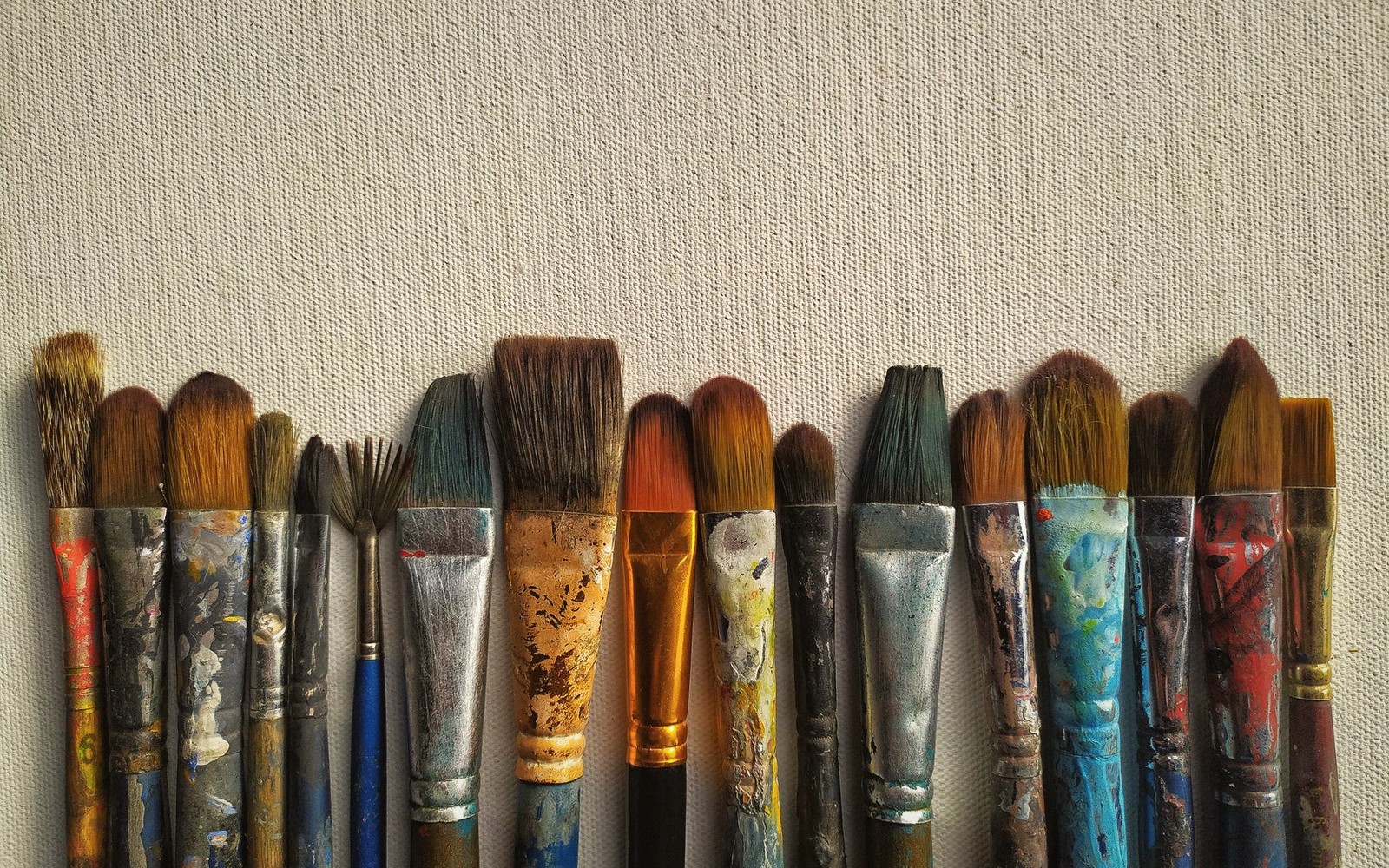
01What the Bristle Is Actually Doing
Every brushstroke is a small negotiation between the paint, the surface and the hairs. Understanding what the bristle is doing mechanically makes every buying decision easier.
Hog bristle — stiff, springy, naturally split at the tip into what's called a "flag2" — is the traditional workhorse of oil painting. Those split ends grip and release paint in a way that flat synthetics don't replicate easily, and the firmness lets you push thick paint around a canvas without the brush collapsing. For anyone working in oils, a decent set of hog brushes is foundational kit. They load well, they scrub into texture, they survive.
Soft hair — sable, squirrel, or the better synthetic alternatives — behaves entirely differently. It carries a lot of liquid, releases it smoothly and holds a point under pressure. This is the territory of watercolour and ink, of fine detail work in oil, of glazing layers where you want the brush to barely touch the surface. A good synthetic soft brush, the nylon or Taklon varieties, has come a very long way in the last two decades; they're worth serious consideration for watercolour and acrylics at almost any price point.
The practical upshot: for oil painting, budget more toward hog and spend less worrying about soft-hair detail brushes. For watercolour, the opposite is true — one excellent soft round will outperform six cheap ones.
02Shape, Size and the Ones You'll Actually Reach For
Flat brushes — the ones with a square-cut edge — are underrated by beginners and indispensable to experienced painters. A flat pulls a crisp edge, makes a wide stroke or a narrow one depending on which side you use, and is excellent for blocking in large areas with purpose. Filberts, which taper to a soft oval, are the diplomatic middle ground: some of the decisiveness of a flat with a softer edge. Rounds hold a reservoir of paint and come to a point for varied-width marks that feel more calligraphic. Fan brushes, despite their popularity in hobby sets, have a narrowly specific use (blending foliage textures, softening edges) and shouldn't dominate a kit.
The most useful starter hog set for oil painting: a couple of flats in medium sizes (somewhere around a No. 8 and a No. 6), one filbert3, one smaller round for tighter passages. That's four brushes. Claude Monet and his contemporaries worked with sets that seem almost sparse to modern eyes — size and variety matter less than quality and knowing what each brush does. Pierre Bonnard's intimate, colour-drenched surfaces were built with relatively modest technical means; it's the painter's eye that multiplies the range of marks, not the brush count.
For acrylic painters, synthetics across all shapes work well — acrylics are harder on bristle than oils, and synthetics hold up better under repeated wet cleaning and the faster-drying paint.
03Cheap, Mid-Range and Worth It
Truly cheap brushes — the kind sold in multipacks for next to nothing — shed hairs into wet paint, lose their shape after a few sessions and make painting harder rather than easier. They're a false economy. Mid-range brushes from established makers (Rosemary & Co, Princeton, Escoda, Winsor & Newton's Monarch or Cotman ranges) give you a working tool that behaves predictably, holds its shape through a session and survives proper care. This is where most painters should spend most of their money. High-end brushes — professional sable, Kolinsky4-tipped rounds — are worth the investment if soft-hair work is central to your practice, but they're not a requirement for getting serious results.
The rule of thumb: buy fewer brushes and spend the savings on quality. Two reliable flats will serve you better than ten unpredictable cheap ones.
04Keeping Them Alive
A brush dies when paint dries in the ferrule1 — the metal collar where bristle meets handle. Once dried paint compacts up there, the hairs splay permanently and the brush is finished. Prevent it by cleaning thoroughly after every session, working paint out from the ferrule first, not just the tips.
For oils, wipe excess paint on a rag, work the brush through a solvent (odourless mineral spirits or a brush soap like The Masters), then wash with mild soap and reshape the bristles before laying the brush flat to dry — never upright in a jar while wet, which forces water into the ferrule and swells and loosens the hairs over time. For acrylics, speed matters more: rinse frequently during a session because dried acrylic is far harder to remove than dried oil.
A brush reviver — Masters Brush Cleaner is the most widely used — can rescue a stiffened brush that hasn't quite hardened completely. Work it in with your fingers under warm water, reshape, and leave it overnight.
Store brushes flat or bristle-up once fully dry. A simple rolled canvas brush holder protects them between sessions without squashing the heads. Treat the brushwork as seriously as the painting itself and a good set of brushes will last years.
Worth knowing
Claude Monet
French Impressionist painter, worked outdoors with direct paint handling
Pierre Bonnard
Post-Impressionist French painter known for colour-rich intimate interiors
Notes
- ferrule. the metal collar joining bristle to brush handle ↩
- flag. the natural split tip of hog bristle, aids paint pickup ↩
- filbert. brush shape with an oval, tapered edge ↩
- Kolinsky. a fine natural hair from the Siberian kolinsky used in top sable brushes ↩
- alla prima. direct, single-session painting; relevant to brush wear rate