01Before the Studio Was the Default
It seems obvious now that painters would work outdoors, but for most of Western art history, the landscape was something you sketched outside and painted properly back in the studio. The grand landscape tradition — Claude, Poussin, the Dutch masters — was a workshop enterprise. Nature was raw material; the finished picture was made somewhere dry and controlled.
What shifted things was a combination of technology and attitude arriving in roughly the same generation. The collapsible metal paint tube, patented in 1841, meant oil painters could carry pre-mixed colour without it drying out or spilling. Before that, bladders of pigment were fragile and inconvenient. The tube made spontaneous outdoor painting genuinely practical, and a group of painters in France were already restless for exactly that kind of freedom.
The Barbizon school3 — painters including Théodore Rousseau, Jean-François Millet and Charles-François Daubigny — settled in the village of Barbizon on the edge of the Fontainebleau forest in the 1830s and 1840s. They weren't trying to start a movement; they were trying to get closer to actual trees, actual light, actual weather. The forest floor, peasants working the fields, the river at particular times of day — these weren't backdrops, they were the point. Their work was quieter and more documentary than the academic ideal, and it was influential enough to make a generation of younger painters feel that the studio was the compromise, not the outdoors.
Those younger painters included Claude Monet. The Impressionists took the Barbizon impulse and turbocharged it with colour theory and sheer speed. Working fast enough to catch a specific light effect before it moved — what Monet called the envelope5, the atmosphere that unified a scene — meant developing a particular kind of seeing and a particular kind of mark. Broken colour, visible brushwork, shadows that weren't brown but blue or violet: these weren't stylistic affectations, they were solutions to the problem of painting what light actually looks like in real time, outside, under a changing sky. Plein-air practice forced the technique.
02What It Does to Your Painting
The practical benefits of painting outdoors are less romantic than they sound, and more fundamental. Working from life means the light is doing something the mind can't simulate: it's bouncing, shifting, falling across forms in ways that photographs flatten and memory simplifies. Paint a bush from a photo and you'll give it a single notional green. Paint it outdoors and you'll find yourself fighting to name what you're actually seeing — a warm yellow-green where the sun hits the top, a grey-blue-green in the shadow side, orange where a branch shows through. The problem of mixing green gets acute and instructive very fast.
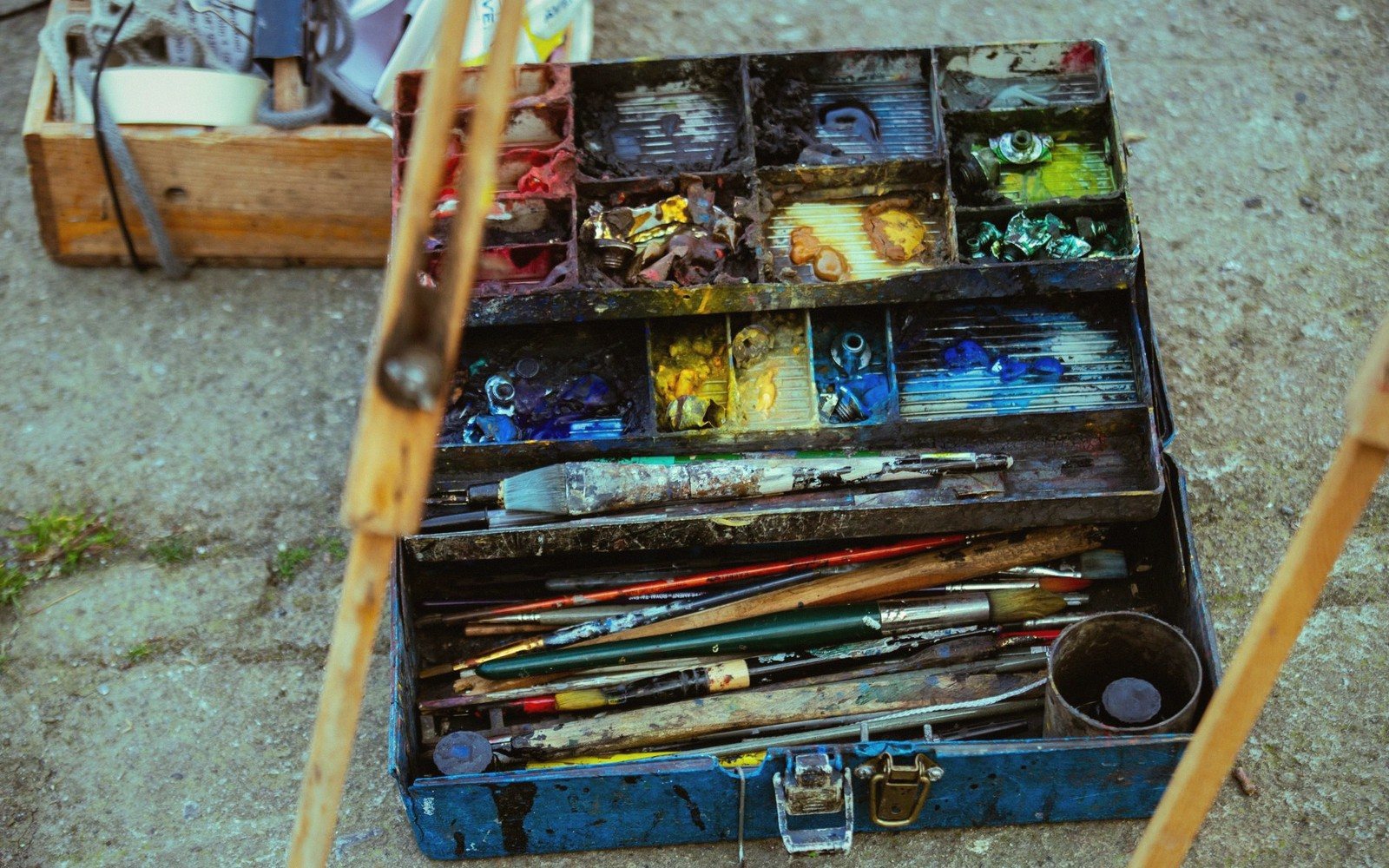
Time pressure is the other teacher. You can't fuss. Plein-air painters typically work on small formats — the pochade box1, a portable painting box with a built-in palette and slots for a small panel, is the standard tool — and they accept that the finished piece might be 15 by 20 centimetres. Small scale and limited time mean you have to prioritise: the light effect first, the big shapes next, everything else only if there's time. Painters who spend months in the studio wrestling with a painting often discover that an hour outside solves problems they didn't know they had about seeing tone and colour relationships.
The pochade box itself is worth knowing about. The name comes from the French pochade, meaning a quick sketch or rough. The traditional version is a wooden box, hinged to hold a panel while you paint and fitted with legs or designed to clamp to a tripod. Modern versions are lighter and often made from aluminium. The principle is the same: everything you need in a box you can carry, set up in minutes, and pack away without disturbing the wet panel. Some painters work even smaller, with a panel held in one hand and a limited palette of four or five tubes. The constraint sharpens everything.
03The Tradition You Can Join
Plein-air painting is one of those rare practices that has stayed genuinely alive rather than becoming purely historical. Every significant tradition feeds into it: the Barbizon painters' commitment to observed nature, the Impressionists' colour intelligence, the alla prima2 directness that Bob Ross (working from a different tradition entirely, with a television studio as his landscape) popularised for a later generation. Plein-air competitions exist around the world, where painters complete finished works on-site within a fixed time. Local painting groups head out to parks, coastlines and fields every weekend in reasonable weather.
You don't need competition to benefit from it. Even one session per month outdoors — a garden, a car park, a view from a window into the open air — recalibrates your eye in a way that no amount of studio work quite matches. It makes you faster, more decisive, less precious about individual marks. The painting you bring home may be scrappy. The seeing you bring home is the point. Barbizon painters knew it, Monet knew it, and anyone who's stood in a field with a brushful of paint and watched the light move will know it too: something clicks into place when the subject is right in front of you, alive and changing and entirely indifferent to how your composition is going.
How it came together
- 1830s–1840sBarbizon painters settle at Fontainebleau; outdoor painting becomes a serious practice
- 1841metal paint tube patented; practical outdoor oil painting becomes viable
- 1860s–1880sImpressionists, including Monet, develop plein-air colour and speed-driven technique
Worth knowing
Barbizon
village on the edge of the Fontainebleau forest, France; base for the Barbizon school
Théodore Rousseau
leading Barbizon painter, championed direct landscape observation
Jean-François Millet
Barbizon painter known for rural subjects and peasant life
Notes
- pochade box. portable painting box with palette, holds a small panel for outdoor work ↩
- alla prima. painting completed in a single wet session, without waiting for layers to dry ↩
- Barbizon school. mid-19th-century French painters who worked outdoors in the Fontainebleau forest ↩
- broken colour. small strokes of separate colour placed side by side rather than blended on the palette
- envelope. Monet's term for the unified atmosphere and light effect across a scene ↩